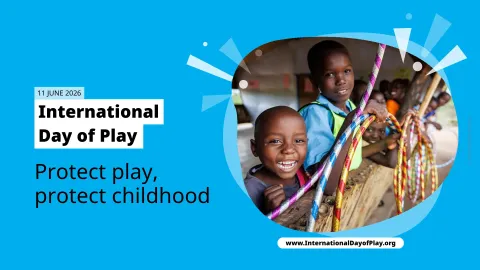
Protect play, protect childhood: cities, get ready for International Day of Play 2026!
On 11 June 2026, the world will mark the International Day of Play. UNICEF is calling on cities and municipalities everywhere to celebrate the day, champion every child’s right to play, and make it visible in their communities.


Established by the United Nations General Assembly and celebrated annually on 11 June, the International Day of Play (IDOP) recognizes the critical role of play in supporting children’s health, learning and development, and calls on governments, institutions, communities and families to prioritize play in everyday life.
The 2026 theme – “Protect play, protect childhood” – is a reminder for all of us that happy, healthy childhoods are built on play, and that protecting children’s time, space and freedom to play is one of the most powerful things a local government can do.
Momentum is building: from 12 May to 11 June
On 12 May 2026 – just one month before the International Day of Play – UNICEF convened a landmark global webinar, “Let’s Celebrate the Right to Play!”. More than 200 city representatives and institutional, civil society and private partners from 25 countries joined to celebrate the right to play, discuss challenges and solutions, and plan for the International Day of Play on 11 June 2026.
Cities including Nottingham (UK), Brussels (Belgium), Regensburg (Germany), Vantaa (Finland) and Boston (USA) shared bold local initiatives – from masterplans for play to children-as-researchers projects and citywide play days. That energy now carries into 11 June, when cities everywhere are invited to take the lead.
A right under threat
Article 31 of the UN Convention on the Rights of the Child guarantees every child the right “to rest, relax, play and to take part in cultural and creative activities.” Play builds social and emotional skills, strengthens creativity and problem-solving, develops resilience, and helps children form meaningful connections.
Yet children today are experiencing a growing play deficit. Around the world, scheduling pressures, shrinking safe public spaces, the privatization of urban space, traffic hazards, air pollution and rapidly changing digital environments are eroding children’s access to free, unstructured play. Too many public environments are simply not designed for the way children play.
Cities are uniquely placed to reverse this trend.
Why cities matter
Cities shape the spaces, policies and programmes that decide how families live, gather and play every day. Municipal leadership has the power to:
- Strengthen family-centred community design
- Expand access to safe, inclusive and well-maintained play spaces
- Support holistic child well-being from infancy through adolescence
- Engage children and young people as partners in shaping play initiatives – not only as beneficiaries
- Elevate play as a shared community value
Through the UNICEF-led Child Friendly Cities Initiative (CFCI) – active in around 35 countries – cities are already showing how policy, planning and public space can come together to protect children’s right to play. The International Day of Play is an opportunity to build on, connect and elevate these existing efforts – and to make them visible.
In 2025, dozens of cities in Germany, the Netherlands, Andorra, Austria, Spain, the United States and other countries already organized events to celebrate this global landmark. In 2026, even more cities are expected to join the global movement!

Four ways your city can participate in 2026
- Citywide celebration with local leaders. Host a central event that brings families, community organizations and partners together – temporarily closing a main street or plaza for children’s play, turning a park into a Play Zone, or inviting officials to join children in play activities.
- Micro-activations across neighbourhoods. Encourage small-scale activities in parks, libraries, community centres and public spaces. “Play Streets” and “Play Zones” are low-cost, highly visible and foster community connection – existing permitting systems for block parties can often be adapted to make this easy for local organizers.
- School and youth engagement. Partner with schools and youth-serving organizations to integrate play-based learning and celebration into classrooms and programmes.
- Public awareness and storytelling. Share local stories and activities through your communications channels and social media. Use #InternationalDayofPlay to connect with the global movement and amplify your impact.
Throughout, children and young people should have a meaningful role in designing and leading activities. When children help shape play in their own neighbourhoods, they become agents of change – and play becomes not just an activity, but an expression of their rights and their voice in the city.
Get started today
Cities and municipalities are invited to visit www.InternationalDayofPlay.org (in Arabic, English, French and Spanish) for the 2026 theme, key messages, free activities, Canva templates, photo and video assets, and examples from around the world. A new municipal guide from UNICEF and the LEGO Group is also available to help cities plan their celebrations.
Child Friendly Cities can contact their UNICEF national office to learn more.